
What if someone handed you tomorrow’s newspaper, and splashed across the front page was the story of your death? Not the date. Not the funeral arrangements. The verdict. Your achievements selected. Your failures remembered. Your reputation hardened into history, with no chance to interrupt, correct, or explain. It sounds like the plot of a novel, but for Alfred Nobel, it happened over breakfast.
In April 1888, a French newspaper announced that Alfred Nobel had died. The obituary was unflattering — a man who had grown rich from death, his fortune built on explosives. There was only one problem. It was Ludvig, Alfred’s older brother, who had passed away in Cannes. Somewhere between the first reports and the printing press, a journalist confused the two. The paper ran a correction the next day, but by then, Alfred had already read the world’s first attempt at summarising his life.
Few people are ever confronted with a question that unsettling. If this is how they remember me now, what will they write when I really am gone?
The Invention Meant to Save Lives
Picture building a railway through a mountain in the mid-1800s. Thousands of labourers attacking solid rock with hammers, drills, and black powder. Progress is slow, and every blast risks collapse or death. Engineers across Europe wanted to connect cities and drive tunnels beneath mountains — what they lacked was a reliable way through the earth. Then chemistry handed them a miracle. And a nightmare.
In 1847, Italian chemist Ascanio Sobrero created nitroglycerin, a colourless liquid with astonishing explosive power. It could shatter rock better than black powder ever had. It could also detonate because a crate was dropped, or the weather turned warm, or fate had simply chosen that day. Transporting it was like carrying a thunderstorm in a bottle. Nobody trusted it. Nobody could ignore it either. Most people saw danger. Alfred Nobel saw possibility.
Born in Stockholm in 1833, Alfred grew up in a household where inventions were dinner conversation. His father, Immanuel, was an engineer whose successes and failures arrived in roughly equal measure. In St Petersburg, Alfred studied chemistry and engineering, but also devoured literature, wrote poetry, and learned several languages. He was never simply a scientist. He was curious about almost everything. That curiosity eventually settled on nitroglycerin. Not because he wanted bigger explosions… he was after smaller tragedies. If the explosive couldn’t be made less powerful, perhaps it could be made more predictable.
The Explosion That Changed Everything
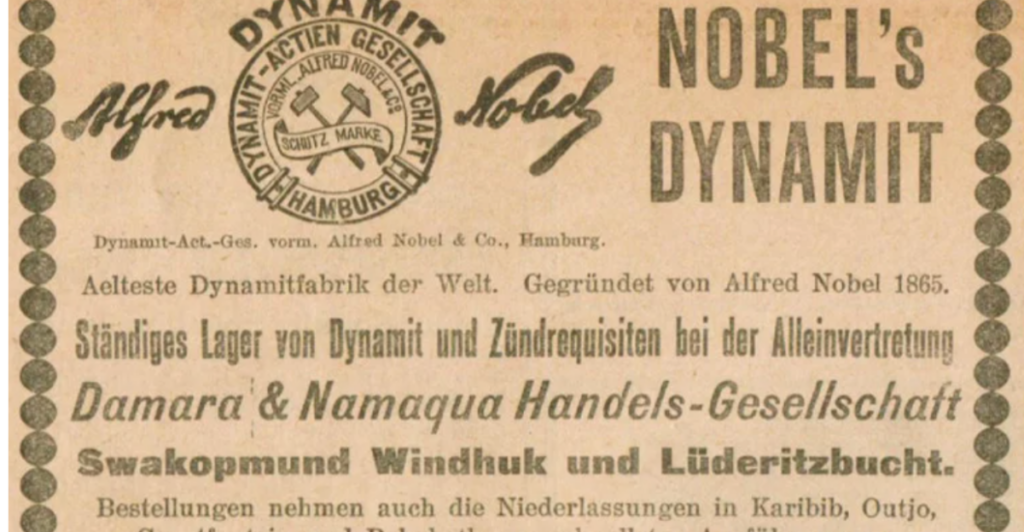
On 3 September 1864, an explosion tore through one of the Nobel family’s workshops outside Stockholm. Five people died, including Alfred’s younger brother, Emil. Many inventors would have walked away. Alfred doubled down — convinced the tragedy proved exactly why the work had to continue. If nitroglycerin stayed unstable, more families would lose sons and brothers. Three years later, he found the answer. Mixing nitroglycerin with a soft, absorbent mineral called kieselguhr produced a compound that kept its explosive force while becoming far safer to handle. In 1867, he patented it under a name borrowed from the Greek word for power: dynamis.
The effect was immediate. Engineers bored through mountains that had resisted generations of builders. Railways reached once-impossible regions. Mines expanded. Roads and bridges appeared where geography had said no. It’s easy to overlook that legacy as it rarely makes dramatic photographs. We notice the mountain because it’s magnificent. We rarely stop to think about the people who persuaded it to move.
When an Invention Leaves Its Inventor
The same dynamite that carved tunnels through the Alps could demolish fortifications. History is full of inventions that outgrow their creators’ intentions — aircraft carried passengers before bombs; nuclear physics lit homes before it devastated cities. Progress and destruction often travel on the same passport.
As Nobel’s factories multiplied across Europe and America, so did his fortune. By the late 1800s, he held more than 350 patents and was among the wealthiest industrialists alive. But public opinion rarely rewards nuance. Newspapers wrote about explosions because explosions sold papers … not about the tunnels completed without incident. People rarely thanked Alfred Nobel for a bridge that stood for a century. They remembered the explosions they could hear. He believed he’d made dangerous work safer. Many believed he’d simply made killing easier. In 1888, unfolding that newspaper, he found out which version had won.
The Story He Didn’t Recognise
Most of us never see our own obituary — someone else writes it, someone else decides what gets a paragraph and what gets left out, and it arrives only once we’re gone. Alfred Nobel had the unsettling privilege of reading his while there was still time to disagree. We don’t know exactly what went through his mind. He already knew what he’d invented. What shocked him was discovering what everyone else thought he’d become. Whether every phrase attributed to that article is historically accurate is still debated, but the judgment was unmistakable. The world had started to see him less as the man who helped build tunnels, and more as the man whose inventions could destroy them.
It was one thing to build a tool. It was another to be blamed for how someone else used it. Nobel never saw himself as an arms merchant chasing profit from war; his patents show someone endlessly solving technical problems. But inventions rarely stay attached to their inventors’ intentions. Once released, they live their own lives. Maybe that’s why the obituary lingered. It wasn’t simply wrong. It was incomplete.
A Will Unlike Any Other
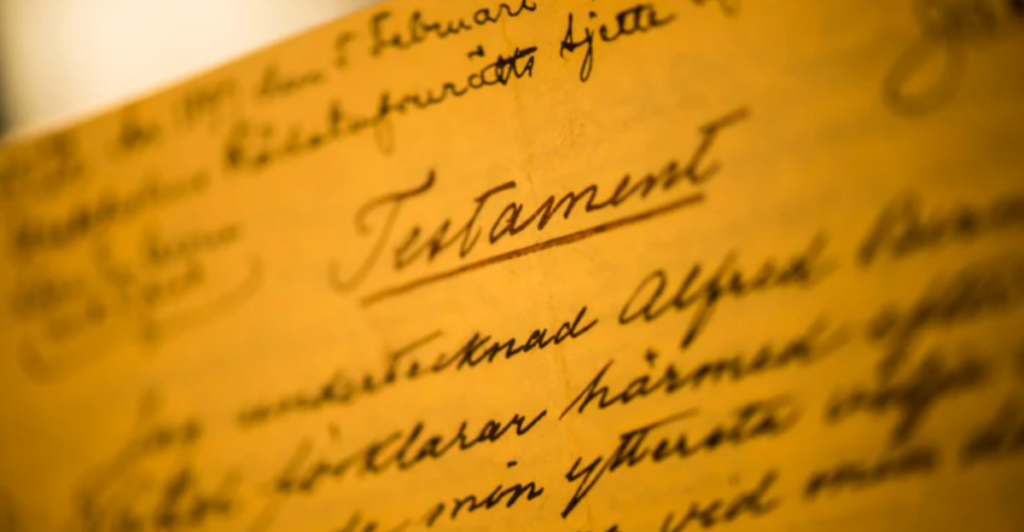
Seven years passed. The newspaper was forgotten by nearly everyone who’d read it. On 27 November 1895, Alfred Nobel walked into the Swedish-Norwegian Club in Paris carrying a document only a few pages long. It would become one of the most extraordinary wills ever written. Most wealthy industrialists left fortunes to family. Nobel had something else in mind: almost his entire estate converted into a fund, its income awarded each year to those whose work provided “the greatest benefit to humankind.” It was 94 percent of everything he owned. Relatives who expected inheritances found themselves largely excluded, and some challenged the will outright. For a while, it looked like his final wishes might never become reality.
But his executors, Ragnar Sohlman and Rudolf Lilljequist, thought otherwise. They spent years untangling businesses, settling disputes, and persuading governments across several countries that Nobel’s unusual vision deserved to be honoured. The man who’d spent his life solving engineering problems had left behind one final puzzle.
The Reveal Nobody Saw Coming
Five years after Nobel’s death, the pieces fell into place. In 1901, the first prizes were awarded — Physics, Chemistry, Physiology or Medicine, Literature, Peace. Today they’re among the highest honours a person can receive. Scientists spend decades chasing discoveries that may never come. Writers spend lives searching for the right words. Peace negotiators measure success in tragedies that never happen. Every October, the world waits for another list of names. Few people stop to ask why the awards exist at all.
History reduces people to a single sentence. Galileo challenged the heavens. Marie Curie discovered radioactivity. The Wright brothers learned to fly. Alfred Nobel invented dynamite. All of those are true. None of them are complete.
His greatest legacy was never the invention that made him rich. It was what he decided his wealth would keep doing after he was gone, a decision that has outlasted nearly everything else about him. The newspaper that accidentally killed him off has all but vanished from history; almost nobody remembers the journalist who mixed up two brothers in 1888. The man that journalist tried to summarise is remembered every single year… in laboratories chasing cures, in concert halls and universities, beside people who work to prevent war rather than wage it.
The obituary tried to tell the world who Alfred Nobel was. History chose a different version, because he did something almost no one else ever gets to do: he read his own ending, and then went back and rewrote it. Most of us will never know what our obituary says. Maybe that’s for the best. But Alfred Nobel’s story leaves behind the question anyway — if you found out today how the world meant to remember you, what would you do differently tomorrow?
🪶 Dive into this next: Before She Became a Headline, Julie Had Already Lived a Lifetime