

Dust rose into the afternoon light as Julie swept it across her back with her trunk. She wandered away from the barn, paused beneath a cork oak and stood there for a while before turning back. About an hour later, she came out again. This time she went farther. By evening, she had crossed more ground than she had that morning, returning several times and venturing a little farther with each walk. Pangea Elephant Sanctuary documented those first quiet hours after her arrival.
It looked like an ordinary afternoon. In many ways, it was. Julie explored the habitat, dusted herself and slowly became familiar with the landscape around her. For the first time in almost forty years, she wasn’t walking because it was time to move on. She was walking because she could.
Before this, almost nothing in Julie’s life belonged to her.
She is believed to have been taken from southern Africa while still young and brought to Portugal in the early 1980s. In 1988, she joined the Víctor Hugo Cardinali Circus, where she would spend almost four decades travelling from one town to the next.
The years passed quietly. Circus tents rose and disappeared. New audiences took their seats while familiar faces slowly vanished from the crowds. Children who once watched the circus grew up and returned with children of their own. Portugal changed around her, but Julie’s world followed a different rhythm. It was measured in performances, transport trailers and the familiar routines that repeated wherever the circus stopped.
She was not alone for most of those years. Julie lived alongside another elephant named Samba, and the two shared their lives for decades. Their longtime owner and caretaker came to know every part of their daily routine, from the food they preferred to the way each responded during veterinary examinations. Veterinarian Graça Oliveira, who had cared for both elephants over the years, would later oversee the health assessments before Julie’s final journey.
Then the world outside the circus began to change.
In 2018, Portugal approved legislation that would bring an end to wild animals performing in travelling circuses. The law introduced a transition period, giving circuses time to relocate the animals in their care while suitable sanctuaries were prepared. Julie stopped performing, but there was still nowhere ready for her to go. As plans for Pangea Elephant Sanctuary slowly became reality in Portugal’s Alentejo region, Julie remained where she was.
Then, in 2024, Samba died.
For the first time in decades, Julie was alone.
What it Took to Move Her
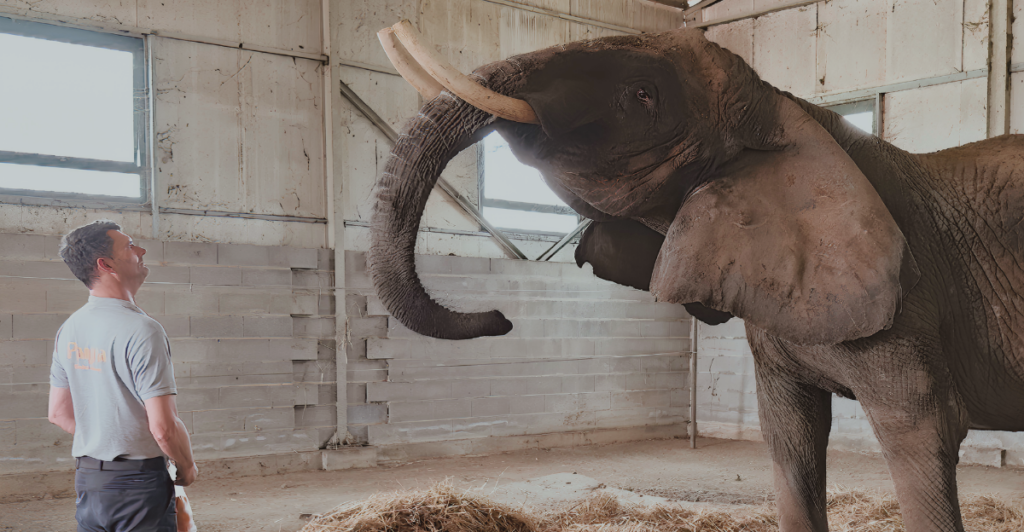
Julie’s move began long before the transport crate arrived.
In the weeks leading up to her departure, the team from Pangea made repeated visits to the circus. They learned the routines that had shaped Julie’s life for decades, from the food she preferred to the way she responded during veterinary examinations. Those details came from the people who knew her best, ensuring as much familiarity as possible travelled with her to Alentejo.
Preparing the sanctuary took even longer.
Pangea did not exist when Portugal decided to phase out wild animals in travelling circuses. It had to be built from the ground up. Across hundreds of hectares of the Alentejo countryside, fences were erected, barns completed, veterinary facilities prepared and browse was planted. Before Julie could begin a new chapter, there first had to be somewhere ready to receive her.
When the day finally came, her move was the result of a voluntary agreement between the Víctor Hugo Cardinali Circus and Pangea Elephant Sanctuary. Cardinali later acknowledged that saying goodbye to an elephant who had been part of the circus for decades had not been easy, but said it was the right decision for Julie.
A New Rhythm
Julie is now in her mid-forties, carrying the stiffness and mobility problems that often come with age. At Pangea, the landscape has been designed with older elephants in mind. Soft ground replaces hard surfaces, gentle slopes encourage natural movement, and mud wallows help protect her skin while specialist veterinary care supports the needs of an ageing elephant.
Life unfolds differently here.
There is no performance schedule and no journey to the next town. New areas of the sanctuary are introduced gradually as Julie becomes familiar with her surroundings. Keepers watch how she walks, where she chooses to rest and which parts of the habitat she returns to most often, allowing her confidence to grow at its own pace.
In time, Julie is expected to be joined by another rescued African elephant, Kariba. Their introduction will happen slowly, beginning with scent and sound before progressing to closer contact if both elephants are comfortable. Like every other part of Julie’s move, it will happen when the elephants are ready rather than according to a timetable. A few days after Julie’s arrival, Pangea co-founder Kate Moore offered a small but encouraging update.
“She has had a hard life, but I must say she has been very energetic at Pangea this week, so we remain hopeful.”
History will remember Julie as Portugal’s last circus elephant, the final survivor of a tradition that once carried wild animals from town to town. As public attitudes changed and legislation followed, that era slowly came to an end. Julie, however, has no reason to think about history. Her world is measured in smaller things now: a branch within reach of her trunk, fresh earth after overnight rain, a favourite patch of shade beneath the cork oaks, another part of the woodland waiting to be explored.
Tomorrow morning, the cork oaks will cast their shadows across the hillside once again. The mud wallow will still be waiting, and the paths through the sanctuary will be exactly where she left them.
For almost forty years, Julie’s life was measured by departures. Today, it is measured differently.
🪶 Dive into this next: History’s Greatest Hoaxes That Fooled the World